Many businesses reach a stage where performance levels off, engagement starts to decline, or projects don’t progress as smoothly as they should. The instinctive response is often, “We need leadership training.” In some cases, that’s exactly what’s required. In many others, the real issue lies elsewhere.
At The Alternative Board, we regularly work with business owners who confuse leadership development with management development. They invest in leadership programs when their managers need stronger day-to-day management skills, or they focus on improving management processes when what the business really needs is leaders who can create a clear vision, inspire confidence and guide their people through change. Understanding the distinction makes it much easier to choose the right training for your people, your business and the next stage of your growth.
Leadership Training vs. Management Training: Understanding The Difference
The terms leadership training and management training are often used interchangeably because the best leaders are usually effective managers, and the best managers demonstrate strong leadership qualities. While the two disciplines complement each other, they are designed to achieve different outcomes.
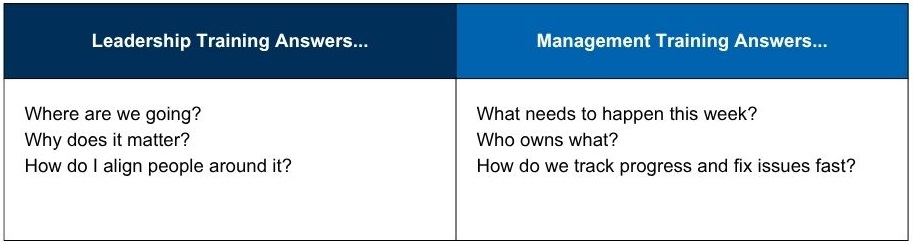
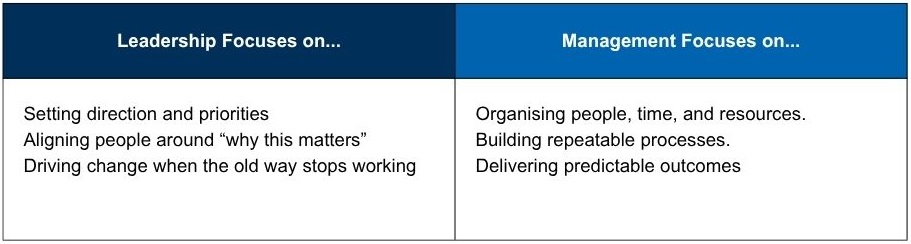
Leadership training focuses on developing the ability to create a vision, inspire others and guide teams towards a shared purpose. It equips people to influence, drive change, build trust and align individuals around common goals.
Management training, on the other hand, is centred on turning that vision into results. It develops the practical skills needed to organise work, set priorities, manage resources, improve processes, hold people accountable and ensure consistent execution.
The Impact of Choosing the Wrong Development Program
Choosing the wrong type of training often means the real problem never gets solved. You’ll typically see one of these two scenarios:
Leadership training when better management is needed
The business invests in leadership development, but execution still falls short. Deadlines are missed, accountability is unclear, and managers avoid difficult performance conversations. The underlying issue is often a lack of practical people management skills.
Management training when stronger leadership is needed
The business improves processes and systems, but the team still lacks direction. Work gets done, yet engagement and motivation decline because people aren’t connected to a clear vision or purpose.
Most Roles Need Both Just in Different Measures
In reality, most people need a combination of leadership and management skills. The balance simply depends on their role, the maturity of the team, the stage of the business and the challenges they’re facing.
A simple guide:
- If your team needs greater clarity, direction and buy-in, focus on leadership training.
- If your team needs stronger consistency, accountability and execution, focus on management training.
Leadership vs. Management In Practice: Vision vs. Execution
Leadership sets the direction. Management turns that vision into action by creating the plan, supporting the team and ensuring consistent execution.
Same Scenario, Two Different Lenses
Scenario A: A key project slips behind schedule
- Leadership lens: Restates the goal and what “done” looks like. Removes confusion: “Here’s the decision. Here’s the direction.” Builds buy in: “Here’s why this matters and what we will stop doing to make room.”
- Management lens: Rebuilds the plan with timeline, milestones, and owners. Sets a check in cadence and escalation path. Locks accountability: “You own X by Friday; I own Y by Wednesday.”
Scenario B: The team resists a new process
- Leadership lens: Names the change and the reason behind it. Addresses fear and friction directly. Models the new behaviour and reinforces the standard.
- Management lens: Documents the workflow and roles. Trains the team on the steps. Audits adoption and corrects gaps.
A Simple Way to Identify What’s Missing
A useful way to diagnose the problem is to listen to what your team is saying.
- If the challenge is, “We’re not sure where we’re heading,” your business probably needs stronger leadership.
- If the challenge is, “We know what needs to be done, but it isn’t happening consistently,” the priority is usually better management.
What Does Leadership Training Typically Cover?
Leadership training helps people move beyond simply managing tasks to setting direction, inspiring others and bringing their team with them.
Skills Developed Through Leadership Training
- Strategic thinking and long-term planning
- Creating a clear vision and setting priorities
- Confident decision-making in uncertain situations
- Influencing and gaining buy-in across teams
- Clear, consistent communication
- Building a positive, high-performing culture
- Leading people through change and uncertainty
- Coaching and developing future leaders
- Encouraging ownership and initiative
- Strengthening team alignment
Behaviours Leadership Training Strengthens
Many leadership development programs also begin with the foundations of effective leadership: developing a clear understanding of personal values, aligning actions with purpose and increasing self-awareness. These behaviours help leaders build trust, communicate with authenticity and create stronger connections with the people they lead
Outcomes You Should Expect
- Faster alignment and clearer decision making
- Greater ownership and initiative across the team
- Increased resilience during periods of change
- A stronger pipeline of future leaders through coaching and development
What Does Management Training Typically Cover?
Management training equips people with the practical skills to lead day-to-day operations more effectively, creating greater consistency, stronger performance and less stress. It’s particularly valuable because many managers step into leadership roles without ever receiving formal training in how to manage people, priorities and performance.
Skills Developed Through Management Training
- Goal setting and planning to turn priorities into achievable outcomes
- Prioritising the work that matters most
- Establishing effective check-ins, reporting rhythms and follow-up processes
- Managing performance through clear expectations and regular feedback
- Creating accountability with defined ownership and deadlines
- Delegating responsibility, not just individual tasks
- Conducting productive one-on-one meetings and performance conversations
- Streamlining processes and improving workflow handovers
- Running focused meetings with clear decisions and action items
- Strengthening cross-functional collaboration to keep work moving
People Systems Management Training Strengthens
- Setting clear performance expectations and monitoring progress
- Creating accountability through defined ownership and deadlines
- Delegating outcomes and empowering team members
- Conducting effective one-on-one meetings and coaching conversations
- Delivering regular, constructive feedback
- Addressing performance issues early and consistently
Operations Management Training Covers
- Improving processes and streamlining workflows
- Running productive meetings with clear agendas, decisions and action items
- Strengthening cross-functional collaboration to keep projects moving
- Creating consistent systems that improve efficiency and execution
Why Leadership & Management Training Matters More Than You Think
The Alternative Board calls out a common pattern: managers often rank among the most poorly trained employees, and many business owners don’t spend enough time teaching managers how to manage. The “accidental manager” problem is real—the 2023 CMI study found 82% of new managers had no formal training Your Team Needs Management Training.
The Core Differences: Mindset, Time Horizon, And Measures of Success
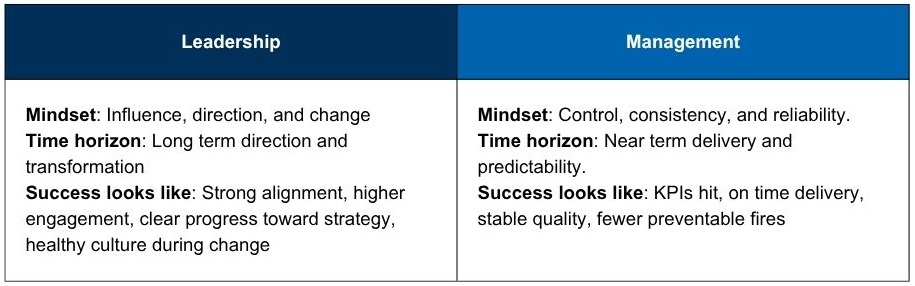
Both matter. The win comes from knowing which one your team lacks right now.
One nuance worth watching: managers may naturally lean risk averse and conflict avoidant—which can protect stability but slow change when the business needs a push. Leadership training often targets that gap directly.
Common Myths: “Leaders Don’t Manage” And “Managers Can’t Lead”
There is a common belief that leaders don’t need management skills, or that managers aren’t expected to lead. In reality, both ideas can hold organisations back.
Myth #1: “Great Leaders Don’t Need Strong Management Skills”
Effective leaders still need strong management skills. They must set clear expectations, create accountability, monitor progress and maintain high standards. Leadership provides the direction, while management ensures the work gets done. Successful organisations rely on both.
Myth #2: “Managers Can’t Be Effective Leaders”
Managers demonstrate leadership every day. Whether they’re coaching team members, building trust, communicating priorities or guiding people through change, they are influencing others and shaping the culture of their teams.
The Reality: Strong Organisations Develop Leaders Who Can Also Manage
The balance between leadership and management changes as responsibilities grow.
- Frontline managers need a stronger focus on management, building capability in planning, coaching, accountability and day-to-day execution.
- Middle managers require a balance of leadership and management, aligning teams, influencing others and delivering results through people.
- Senior leaders and executives need a greater emphasis on leadership, setting strategy, shaping culture and leading change, while maintaining enough management discipline to ensure plans are successfully executed.
How To Tell Which Your Team Needs Right Now
Signs Your Business May Have a Management Gap
- Missed deadlines or “surprise” delays
- Unclear ownership (“I thought they had it”)
- Inconsistent 1 on 1s or vague expectations
- Weak accountability and follow through
- Low morale or “checked out” energy
- Lack of direction or too many shifting priorities
- Resistance to change, even when the change makes sense
- Poor alignment across teams (everyone rows in a different direction)
Answer yes or no to each question:
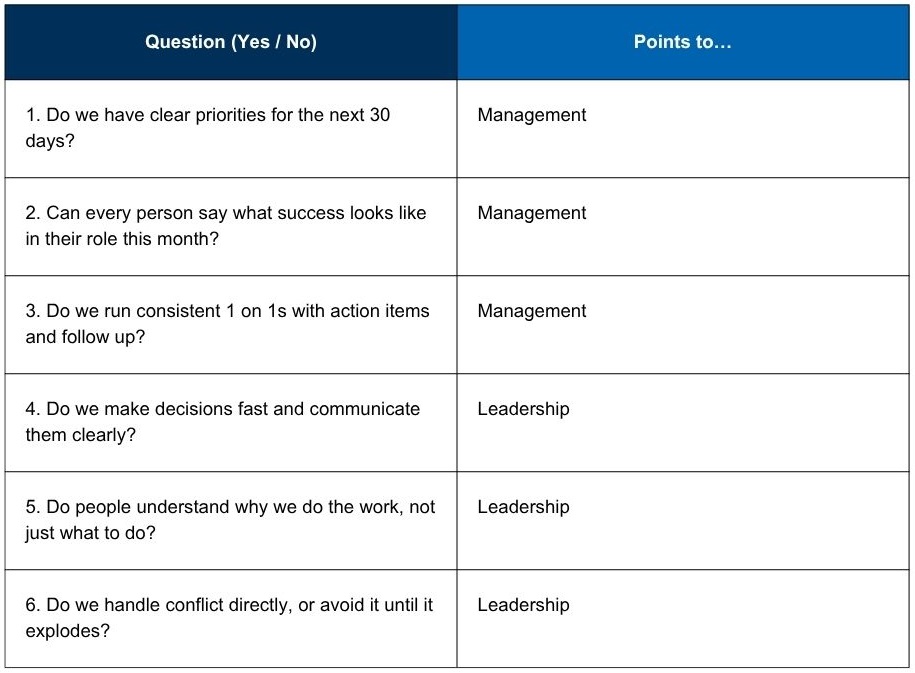
Choosing The Right Training For Every Level Of Your Organisation
New Managers (0–18 Months): Focus on Building Strong Management Foundations
Many first time managers find themselves in the role without any formal management training. Before developing advanced leadership skills, they need a solid foundation in managing people and performance.
Recommended focus areas:
- Delegating effectively with clear outcomes, responsibilities and deadlines
- Delivering constructive feedback and managing performance conversations
- Running consistent one-on-one meetings and productive team meetings
Experienced Managers: Lead Through Others and Across the Business
As responsibilities expand, experienced managers need to spend less time solving problems themselves and more time leading, influencing and developing others. Recommended focus areas:
- Coaching and developing people rather than solving every problem
- Building influence across teams and departments
- Communicating change with clarity and gaining alignment
- Applying leadership frameworks, such as the CARE model (Clarity, Autonomy, Relationships and Equity), to create engaged, high-performing teams
Executives: Leading Strategy, Culture and Organisational Change
While executives still need strong management discipline, their greatest impact comes from providing strategic leadership and shaping the future of the organisation. Recommended focus areas:
- Strategic leadership and confident decision-making
- Building a strong organisational culture and effective operating model
- Leading large-scale change while maintaining engagement and wellbeing
Choosing The Right Balance: A Simple Decision Framework
A Simple Decision Tree
What stage is your business in?
Fast growth or significant change? Focus on leadership training.
Improving operations or scaling delivery? Focus on management training.
What challenges are you seeing?
Execution, accountability or consistency issues? Management training.
Direction, engagement or change challenges? Leadership training.
Who is the training for?
New managers? Start with management fundamentals.
Senior leaders? Focus on leadership, supported by strong management practices.
Recommended Blend by Role Level
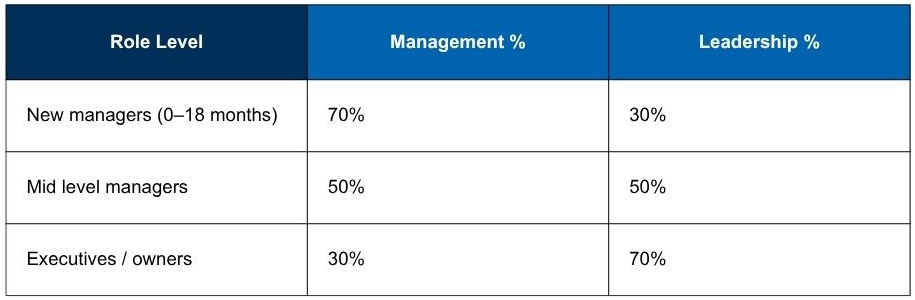
If your organisation has many accidental managers or clear execution pain, shift more time toward management skills first.
Next Steps You Can Take This Month
- Assess the gaps: Identify where managers and teams are struggling most, whether it’s planning, delegation, communication, feedback or leading change.
- Start with one group: Focus on a single audience, such as new or experienced managers, and one priority skill to improve.
- Create a development plan: Build a 6–12 week program that combines training, practice and ongoing reinforcement. Lasting leadership and management capability is developed over time, not in a single workshop.
Ready to Close the Gap? The Alternative Board Has Tools for Both
Knowing which type of training your team needs is the first step. Having the right tools to deliver it is the next one.
If your diagnosis points to a management gap — missed deadlines, unclear ownership, inconsistent feedback, accidental managers who never got a real playbook — The Alternative Board’s HI-MAP program is built for exactly that. HI-MAP gives managers the practical skills, systems, and habits they need to run their teams with consistency and confidence, without the guesswork.
If your diagnosis points to a leadership gap — low alignment, shifting priorities, a team that lacks direction or buy in on where the business is going — StratPro is where that work happens. StratPro is The Alternative Board’s leadership alignment process, designed to help business owners and their leadership teams get clear on strategy, close the gap between vision and execution, and move everyone in the same direction.
Most businesses need both over time. Start with whichever gap is costing you the most right now.